Where do eggs come from in Build an Ant Empire?
From the Ant Queen. She generates an egg, and you pay Cash for the ant on the podium. Place that ant in a colony slot so it can produce food boxes.

This Build an Ant Empire eggs guide is for Roblox Place 78490532994307 by Insect Kingdom studio. The Ant Queen is the confirmed source of new workers: she produces an egg, an ant shows on the buy podium, and you pay Cash to take it. Public notes name the opening egg as Common. Higher rarities are mentioned, and their names, odds, and any pity counter stay off this page until a verified HUD capture exists. Verified September 30, 2026. Play on Roblox.
The listing line is the whole economy: “Roll new ants, collect food, earn money, upgrade your colony, and unlock powerful new ants.” Eggs are the front of that sentence. A bought ant only pays you after it is placed, food boxes hit the collection station, and those boxes reach the Sell station. Roblox · Desktop, Mobile, Console, Tablet. Free to play on Roblox (Robux shop optional).
| Fact | Detail |
|---|---|
| Place | 78490532994307 |
| Developer | Insect Kingdom studio |
| Egg source | Ant Queen — she generates a buyable ant egg |
| Starter rarity | Common (only rarity name confirmed in public notes) |
| Cash gate | Buying the ant on the podium |
| Roll cost | Recaps say the roll itself may be free — confirm on the Queen UI |
| Egg Luck | Better chance at a higher-quality ant · exact percent TBA |
| Egg Rolls | More rolls or more chances · live tooltip wins |
| First slot | One colony slot is free; further slots cost rising Cash |
| Hatch percents | Not published — this page does not invent a drop table |
| Last verified | September 30, 2026 |
Matched by build plan, shared topics, and guide progression — not random related links.
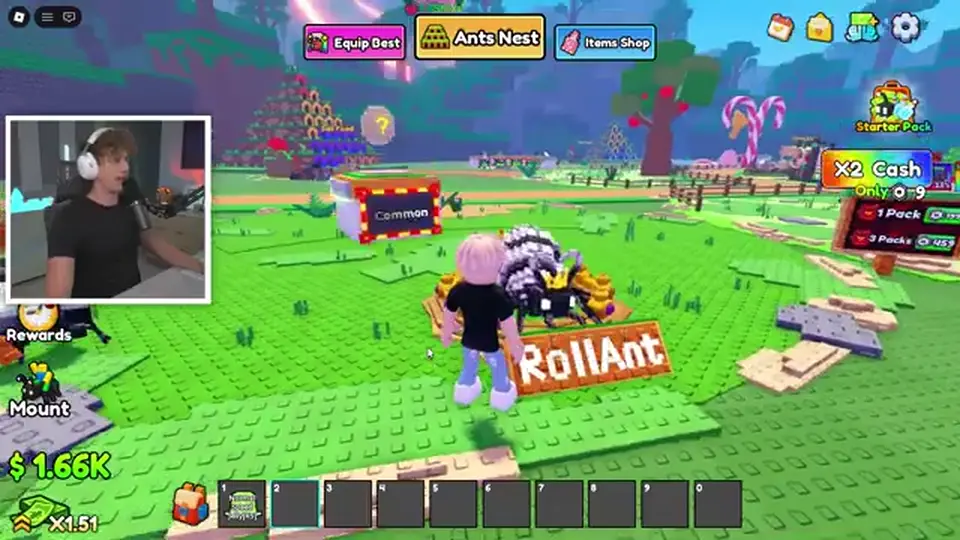
Join Place 78490532994307 and walk to the Ant Queen. She is the NPC that generates the egg. Public notes describe a two-step buy: the Queen produces the egg, then you purchase the ant that comes out of it. The opening result they name is a Common egg. Treat any other rarity word on a thumbnail as unverified until it appears on your own Queen UI.
Default controls from the same notes: move with W A S D, jump with Space, interact with E. After the purchase, place the ant in a free colony slot. You start with one slot. Extra slots are Cash purchases, and the price climbs as the colony grows. A bought ant that never gets a slot does not print food.

Placed ants produce food on their own. The food shows up as boxes at the collection station. You walk there, pick the boxes up, and sell them at the Sell station. That Cash is the only confirmed currency for more ants, more slots, Egg Luck, Egg Rolls, Food Value, ant speed, and the Items Shop.
Rarity is the public shortcut for production value: a higher rarity is described as making more valuable food. Exact food-per-minute numbers are TBA, so compare two ants by watching the boxes they fill, not by a spreadsheet this wiki invented.
Two Queen-side upgrades show up in every early-game recap, and both are described as cheap relative to mutation potions. Egg Luck raises the chance of a higher-quality ant. Egg Rolls adds rolls or roll chances. Public notes do not say which of those two Roll wordings is on the button, and they do not publish a percent per Luck level. The tooltip on your board is the number that counts.
They sit early because they change every future podium, while a single ant purchase changes one slot. The practical order in the same notes: get a stronger ant when one is affordable, raise Egg Luck, raise Egg Rolls, and always leave enough Cash to buy the ant the Queen is showing. Base colony upgrades come before billion-scale shop items. Full buy order: upgrades.
| Upgrade | What notes claim | What stays TBA | Early move |
|---|---|---|---|
| Egg Luck | Higher chance of a better ant | Percent per level, cap, pity | Buy while it is still cheap |
| Egg Rolls | More rolls or more chances | Which of those two the button does | Buy alongside Luck, not instead of a podium ant |
| Podium ant | The worker you can place today | Price curve by rarity | Buy it if the reserve survives |
| Extra slot | Another ant producing at once | Exact next-slot price | Buy when the current slots are full |
Upgrade prices use Cash, and the next rank costs more than the last. Luck and Rolls are called out as low early costs with a long tail of value. Waiting until you “feel rich” means paying the climbed price for the same first ranks. Take the early ranks, then stop if the next rank would leave you unable to buy the podium ant.
A Luck rank is a bias toward better ants. It is not a posted percent, and it is not permission to paste odds from a video overlay. If your board shows “+5%” or any other figure, that figure is yours to trust for that session. This wiki keeps the cell as TBA until the same number shows up in more than one dated screenshot.
Species names are in the same bucket. Common is the only rarity word the notes actually attach to the starter egg. A list of named ants from another colony game does not fill the blank.
Buy the podium ant when three things are true: you have a free slot or you can afford the next slot, the price leaves you enough Cash to keep rolling, and the ant is better than what is already working. Skip it when the price would freeze the colony — no boxes, no Sell, no next upgrade. The Queen can show another ant later. A stalled food line cannot.
Recaps are consistent on the reserve rule even when they disagree on exact upgrade math: hold Cash for the ant on the podium. Rolling that you cannot cash out is a spectator loop. The Items Shop in the middle of the map is a later sink. Leaf potions start at $1M and Starlight is listed at $5.1Qi. Neither belongs in the same decision as your first Common worker. Shop prices: items.
| Podium situation | Buy | Wait |
|---|---|---|
| First Common, empty slot | Yes — you need a worker printing boxes | |
| Clear upgrade over your placed ant, reserve remains | Yes — replace the weak producer | |
| Price equals your entire Cash | Wait — you cannot sell your way back | |
| Same quality as a slot you already filled | Wait — spend the Cash on Luck, Rolls, or a slot | |
| You would have to sell the food line to afford it | Wait — boxes first |
The first slot is free. Every slot after that is a Cash purchase, and notes say the price rises as you expand. Slot count is how many ants produce at once, so a great podium ant with nowhere to stand is inventory, not income. If the slot button is cheaper than the ant and your current slots are full, buy the slot, place what you have, then return to the Queen.
Exact slot prices are TBA. Write down the number on the button when you buy it. A guessed ladder would go stale the first time the board changes.
Place the Common ant, sell its boxes, and use that Cash to bias the next eggs. Higher rarity is described as higher production value. Until names are confirmed, judge the offer by the rarity label and the food you watch it make after placement. Keeper rules and what “higher rarity” has been seen to mean: ants.
A percent table would have to name every rarity and every ant, then attach a rate. The public notes for this Place do not contain that list. They confirm Common as the starter, they confirm that Luck and Rolls push quality and attempt count, and they stop there. Printing “0.5%” because a thumbnail did would be a fake drop rate.
The same gap covers pity, duplicate handling, and whether a mutation can appear on the egg itself. Mutation potions are a shop purchase you apply to an ant you already own. They are not a hatch bonus this page can chart. Multipliers, from Leaf at 1.35x through Starlight at 5x: mutations.
| Claim you may see elsewhere | Status on this page |
|---|---|
| Full ant name list | TBA — no invented species |
| Rarity names past Common | TBA |
| Per-rarity hatch percent | TBA — no invented rates |
| Pity or mercy timer | TBA |
| Luck percent per rank | TBA — read the live board |
| Egg Rolls = extra rolls vs extra chances | TBA — tooltip wins |
| Mutation on the egg at hatch | TBA — potions are the confirmed apply path |
| Free roll, paid ant | Recap only — confirm both buttons |
Screenshot the Queen offer, the Cash price, your Luck rank, and your Rolls rank before you buy. After you place the ant, note how the food boxes compare with the previous worker. Ten of those rows from your own server beat a borrowed percent table. Send nothing to this page that is only an overlay from a different game.
Codes, when one is listed, are described as a timed Cash Boost rather than a free ant. A boost helps the Sell station while you are actually carrying boxes. It does not fill in missing hatch odds. Check the working row, including the Sep 29 versus Sep 30 source split, on codes before you plan a session around it.
If you are still on the first Common ant, the beginner guide walks the same loop with the first-hour order spelled out as steps.
Most stalled colonies are a Cash-order problem. The Queen, the slot button, Luck, Rolls, and the Items Shop all spend the same Cash. The food line is the only thing that refills it. Anything that pauses placement pauses the refill.
| Habit | What it costs you | Replacement |
|---|---|---|
| Rolling with zero Cash left for the podium | An ant you can see and cannot take | Keep a buy reserve |
| Buying a mutation potion before Luck and Rolls | A permanent multiplier on a Common ant, and no better eggs | Luck and Rolls first |
| Leaving the new ant unplaced | No food boxes from that purchase | Place it before you roll again |
| Buying slots you cannot fill | Cash parked in empty pads | Fill the slots you have |
| Mount-training the worker you just bought | That ant leaves production even if training fails | Train a spare, later |
| Trusting a species tier list | Decisions based on names this Place has not confirmed | Use the rarity label you can see |
The Mount Training NPC takes the ant you submit. Notes say the train can succeed or fail, and either way that ant stops producing food. The ride that comes out is only slightly faster than walking, and the colony already offers a teleport home. A first-hour Common ant belongs in a slot. Training is a later luxury for a duplicate you can lose.
Speed jellies and mutation potions are one-time Items Shop purchases. They are real, and they are priced for a colony that already sells boxes quickly. The $10K speed jelly is the only shop row that sits near early Cash. Everything above the $100K removal potion is a mid or late buy. If a potion price has a B, T, Qa, or Qi suffix, it is not an egg upgrade.
Next, lock the upgrade order so Luck and Rolls stay ahead of that shop: upgrades.
Place the worker and read rarity the way the colony actually uses it on ants. The early Cash order — Luck, Rolls, slots, Food Value, speed — is on upgrades.
When the colony can fund a potion, match the multiplier on mutations to the price on items. A timed Cash Boost, if one is listed, is on codes. First-hour steps: beginner guide.
From the Ant Queen. She generates an egg, and you pay Cash for the ant on the podium. Place that ant in a colony slot so it can produce food boxes.
Public notes say the Queen starts by generating a Common egg. Names and rates for higher rarities are not confirmed, so this page does not list them.
Recaps say the roll may be free and the ant purchase is the Cash gate. Read both controls on the Queen. If the live roll button shows a price, that price is the one to pay.
Buy the ant when you can place it and still keep rolling. Put spare Cash into Egg Luck and Egg Rolls while those ranks are cheap. Do not spend the podium reserve on a shop potion.
Egg Luck is described as a better chance at a higher-quality ant. Egg Rolls is described as more rolls or more chances. Exact percents and the precise Rolls effect are TBA — use the tooltip.
Place the ant in a colony slot. Food boxes show up at the collection station. Carry them to the Sell station for Cash.
No public source for this Place prints a full rarity table or hatch percents. Inventing either would be a fake drop rate. Log your own Queen screenshots instead.
September 30, 2026
Matched by build plan, shared topics, and guide progression — not random related links.